
Eight Mistakes to Avoid when Importing a Trailer into Australia
Importing a trailer into Australia has never been more accessible. With the introduction of the Road Vehicle Standards (RVS) framework and the ROVER portal, manufacturers, importers and even private individuals can apply for approvals online.
Unfortunately, making an application is much easier than making the right application.
At BTT Engineering, we regularly speak with businesses and individuals who have purchased a trailer or a batch of trailers from overseas, only to discover that obtaining approval is far more complicated than they expected. In many cases, the trailer itself isn't the problem. The challenges arise because key decisions were made before anyone considered what would be needed to satisfy the Australian approval process.
This article isn't intended to discourage people from importing trailers. Quite the opposite. Australia has a robust approval framework, and many import projects are highly successful. Our aim is simply to highlight the mistakes we see repeated most often so you can avoid them before they become expensive.
Here are eight of the most common mistakes we see - and how to avoid them.
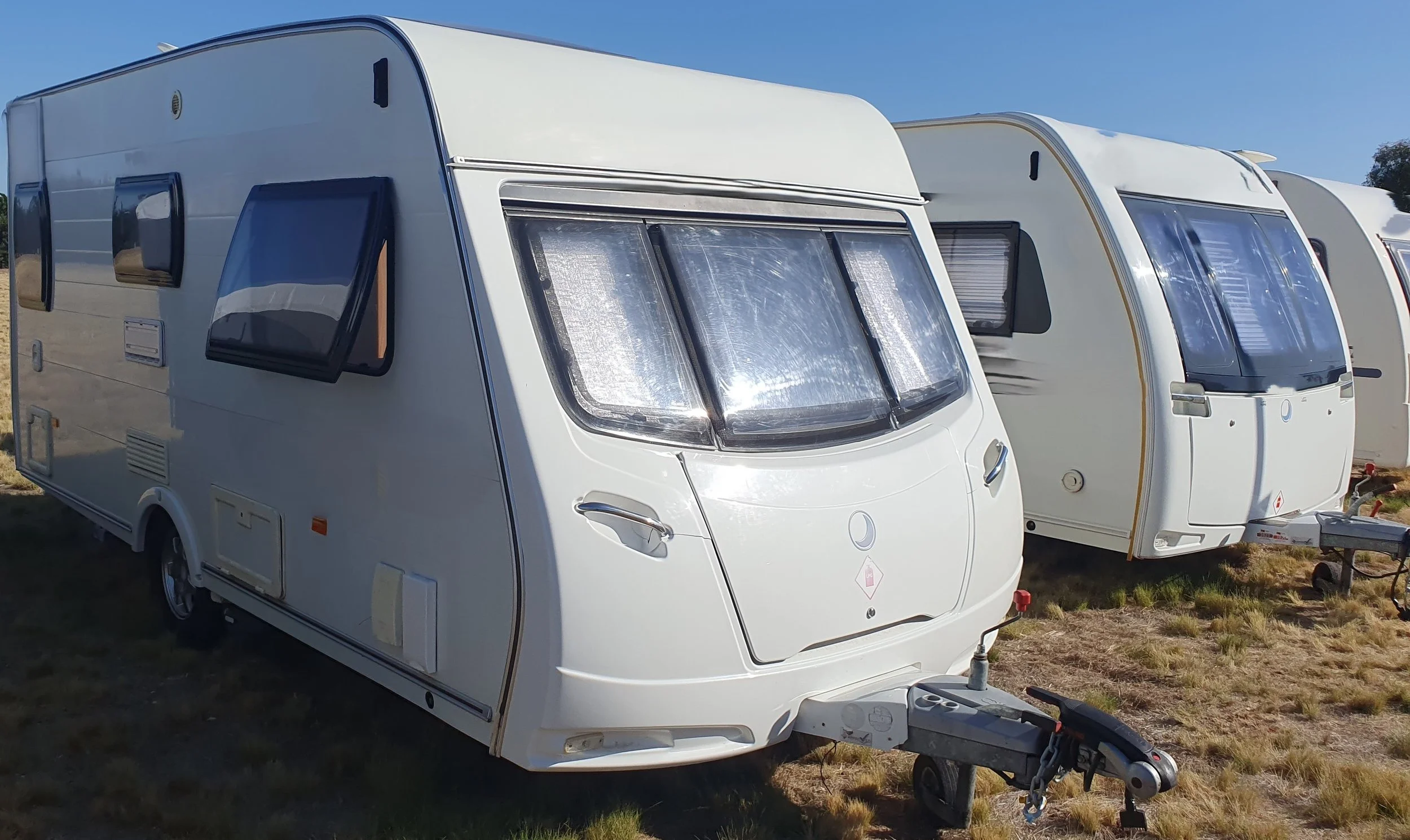
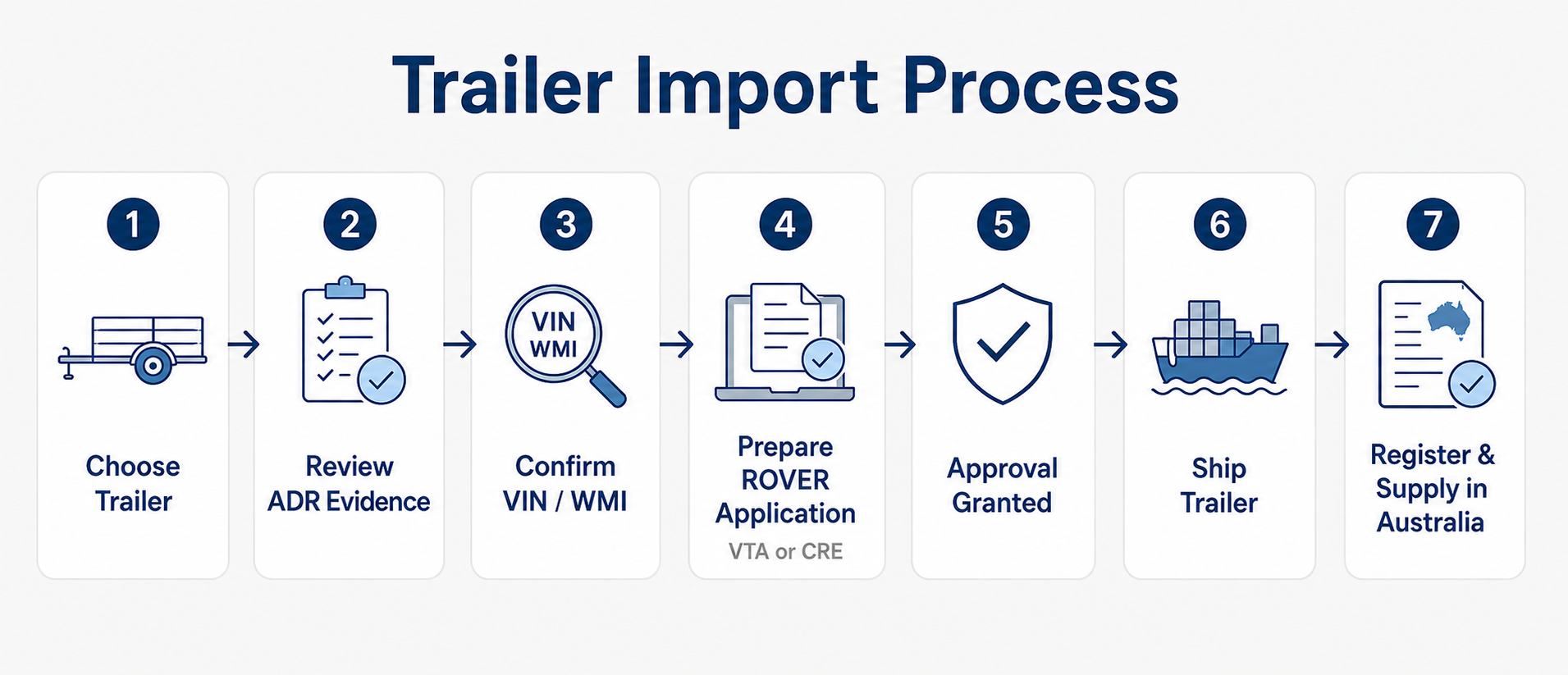
A simplified trailer import pathway. The evidence, VIN and approval arrangements should be confirmed before shipping.
Mistake #1 - Assuming a light (or heavy) trailer doesn't need ADR evidence
This may seem obvious, but in the middle of a ROVER application it can get confusing as to what you are actually expected to have in regards to documentation.
When an application lists “full compliance” for an ADR, under the RVSA legislation this means you are making a legally binding declaration that you comply with that ADR. As part of that declaration, for a VTA or a CRE you’re expected to have the documentation on file to produce on demand.
Two things could happen for an application made without having ADR evidence on file: it either gets an RFI (Request for Information) asking for proof of compliance which holds up the application while the evidence is generated, or it gets accepted without any questions. The second outcome may sound appealing, but it carries a significant hidden risk. Approval holders remain responsible for compliance and may later face rectification, recall or enforcement action if they cannot substantiate their declarations or if supplied trailers are found to be non-compliant.
A common scenario: Just because it is a trailer doesn’t mean it is compliant
An importer purchases a single light trailer from overseas because it is cheaper than having one manufactured in Australia. They submit and pay for the application before receiving an RFI requesting evidence of drawbar compliance. Client doesn’t have this documentation. This takes time and money to fix which was not accounted for in the initial purchase.
We’ve seen this happen: It was approved and it was non-compliant
A client gets a Vehicle Type Approval for their caravan model which is to be coming in from overseas. They have some documentation in place and their application was successful. A customer complaint prompts the department to review the approval., who ask them to produce the evidence that the trailers supplied comply with all ADRs. The evidence is not present and it is found they don’t comply with a general clause in one of the ADRs, so under the RVSA legislation the importer was required to recall all affected vehicles for rectification, regardless of where they are in Australia. Not ideal and not a 5 minute fix!
How to avoid this mistake: Don’t submit a VTA or CRE application unless you have documented evidence you comply with all ADRs.
Mistake #2 - Buying a trailer because the manufacturer told you it was “ADR compliant”
Understanding that ADR evidence is required is only the first step. The next mistake is accepting a manufacturer’s or seller’s assurance that the evidence already exists without reviewing it before purchase. This can be very easy to do when the party you’re dealing with is advising you “they are compliant in Australia” and lists some of the other companies they’ve sold to in the past.
Issue is, you’ve got no control or oversight with what happened in the previous application(s) and when they were made, so even though the company you’re buying from may be acting in good faith, you don’t know whether regulations have changed since they last sold one to Australia or whether the person who imported them just got lucky in their application and was never questioned for evidence.
A common scenario: Lots of experience supplying to the Australian market without any experience with ADRs?
A client buys a small batch of light trailers for their fleet and has been told that other importers have also brought their products into Australia. An RFI appears shortly after paying for the application asking to prove compliance of the drawbar. Client asks the manufacturer for this documentation and they do not have any knowledge of how to comply with this ADR. The money’s gone from the client’s bank account but now there’s a major hold-up before they get any return on their investment
A common scenario: The rules changed but the manufacturing did not
A client sees a new heavy tri-axle semi-trailer listed for sale on Facebook at a good price. The manufacturer has supplied these trailers to Australia before and therefore it is assumed they’re up to date with Australian regulations. The client snaps up the deal and then engages their engineer to help with the importation and approval process. After paying for the trailer, it is discovered that this trailer does not have EBS as mandated from ADR 38/05 onwards, only ABS. A dispute arises which ends up unfruitful and the client is stuck paying for a local company to re-fit equipment that should have already been on the trailer once it gets to Australia.
How to avoid this mistake: Before committing to purchase, confirm that the manufacturer can provide evidence demonstrating compliance with every applicable ADR - not simply that they've supplied trailers to Australia before.
Mistake #3 - Waiting until the trailer is on the water to start your ROVER application
This is a simple one but can be very costly. The RVSA legislated processing periods for applications are up to 60 business days for a VTA and 30 business days for a CRE, excluding periods when the decision clock is paused while requested information is outstanding. If your trailer(s) arrive in Australia before your approval does, you’ll be stuck paying fees per day at the port until your approval arrives because the trailers cannot be released without it.
A common scenario: An expensive wait at the docks
A client has purchased a batch of trailers that comply with all the rules and regulations and is on its way to Australia to sell to the local market. Halfway along the journey, they finally get around to submitting their VTA. Trailers arrive and are ready to sell and register except for one big problem: they’re not allowed to collect them yet. Meanwhile their profit margin on each trailer is being paid to the port as opposed to the important stuff, like running their business.
How to avoid this mistake: Do not ship any trailers until the relevant approval (VTA or CRE) is in place.
Mistake #4 - Getting a Vehicle Type Approval for trailers without getting VINs
A Vehicle Type Approval is not the only thing you need to be able to register imported trailers - you’ll need a unique VIN for each one. To assign a VIN, you need a unique WMI (World Manufacturer Identifier) and the associated VIN decode approved by a national authority to ensure that the same VIN is not present anywhere else in the world.
NEVDIS maintains the national VIN database and validates, decodes and uploads VINs for registration. Australian manufacturers can obtain a WMI and VIN structure through NEVDIS, while an overseas manufacturer must obtain these through the relevant authority in the country of manufacture. For importers this means that the trailer must come with a legitimate VIN (supported by evidence of WMI and decode) and there are no workarounds when supplying under a VTA.
The only minor concessional available is that VINs may be generated for overseas imports without a VIN undergoing a Concessional RAV Entry, but the volume of CREs allowed in a rolling 12 month period are limited
A common scenario: Approved to supply as many trailers as they want but can’t supply any
A client purchases a batch of shiny new solar powered worksite light trailers and successfully applies for their VTA. The trailers arrive in Australia, make it through customs but don’t have any VINs. A short discussion with NEVDIS confirms they aren’t eligible for a WMI and the manufacturer doesn’t know anything about WMIs or decodes because that type of trailer doesn’t need a VIN in their country. The trailers cannot be registered so while they can do their job on a worksite away from public roads, the new trailers need to be transported… atop another trailer to legally use the road between sites. Kind of defeats the point doesn’t it?
We’ve seen this happen: VINs that don’t make any sense
The above client has learnt their lesson and now gets the trailers from a different importer who provides them a list of VINs prior to purchase. This should solve the problem right? Unfortunately for them, the trailers arrive and when the VINs go to get uploaded to NEVDIS everyone realises the WMI certificate, VIN decode and the VINs themselves all are completely different. Back to square one…
How to avoid this mistake: Engage an accredited NEVDIS VIN submission agent to help load the manufacturer’s VINs and review documentation before committing to large orders of trailers.
Mistake #5 - Applying in your own name when the approval should belong to your business
Regardless of which email address is used, a ROVER account is created in the name of a person, who needs to provide proof of identity before doing anything in the portal. Your business is a separate entity, having its own ABN (and ACN where applicable) and with the capability of having multiple individuals acting on its behalf in ROVER, such as getting a consultant to arrange the type approvals while someone from the office manages the RAV submissions.
Provided that you are working under the banner of your business, you need to ensure the application is under the business’ name.
A common scenario: An application that is a waste of time and money
Jane Citizen creates their ROVER account and submits a VTA for their trailer company. Or at least they thought it was for their company - the submission gets RFIs from the Department stating that the name on the commercial agreements, QMS and other documentation doesn’t match the applicant’s name. The reason: they submitted the application under their own personal name rather than their business name. The application is scrapped, the assessment fee is lost and Jane needs to start all over again with a new submission, this time in the business’ name
How to avoid this mistake: Record and have approved an authority to act for your business prior to starting any application so the application is done in the business’ name
Mistake #6 - Assuming overseas approvals automatically satisfy Australian requirements
Having an approval overseas, especially under the UNECE approval process, can help make documenting compliance for trailers to a number of ADRs trivial. Approvals in other countries and jurisdictions, including USA (FMVSS), Japan (JIS) and Europe (EC), can also help demonstrate compliance for certain ADRs. This doesn’t mean the trailer automatically complies with all ADRs - some ADRs have requirements that are Australian-specific. In addition, when it comes to heavy trailers, different axle spacings and loads are allowed on roads in other countries but not in Australia.
A common scenario: Australia is a different country with different requirements
A client imports light trailers from Europe under a VTA, which have a type approval in Europe under the UNECE regulations. As part of the compliance, it shows they comply with UNECE R55 for couplings, an equivalent of the coupling section of ADR 62. Their first client buys a dozen trailers which travel from the importer’s base in Queensland down to Victoria. As the trailers go for a pre-registration check, the inspector points out that no safety chains are fitted as per ADR 62 and that they can’t be registered. A very unhappy trailer owner calls the importer and the importer gets a third party to complete the remedial work at a premium, which has resolved the problem but left the buyer with a bad taste in a scenario where everyone feels worse off.
A common scenario: Not built for Australian roads (or Australian roads not built for it)
An amusement ride operator brings a large semi-trailer with a brand new ride mounted on top. The European manufacturer produces a high-quality product and holds comprehensive European approvals and supporting documentation. The million-dollar unit arrives in Australia and is weighed only to find that the tri-axle group load exceeds the mass limits set out in the Heavy Vehicle National Law and while permits can be applied for, each jurisdiction won’t allow loading that heavy on their roads. To move the trailer, the options now are either put it on top of another trailer or unbolt and transport part of the ride on another trailer, both of which waste a lot of time and money.
How to avoid this mistake: consider overseas compliance potentially helpful but not a deal-clincher during the buying stage and engage an independent engineer to identify any potential gaps in the compliance prior to overcommitting.
Mistake #7 - Purchasing a second-hand trailer without manufacturer support
While this one isn’t a deal breaker, it can make the process significantly harder (or more expensive) to prove ADR compliance if you purchase a second-hand trailer from overseas with limited support from the manufacturer. While the trailer might have all of the equipment on it to comply with ADRs, showing that the equipment complies usually requires being able to identify the make, model and associated approval numbers. On items such as lights and tyres UNECE markings can make this easy, but for other assemblies markings may not be mandated by regulations or the markings become illegible over time through wear and tear. This means that the component either needs to be tested or replaced, something that should be factored in when budgeting for the trailer’s purchase.
A common scenario: Trailer parts that look good but can’t be used
A client purchases a heavy trailer from overseas which was manufactured 15 years ago. The trailer has braked axles and an EBS installation, so at first glance it appears to have the necessary braking equipment. However, there is no evidence of its braking performance and insufficient information to complete the required ADR 38 assessment. The trailer is imported into Australia where the client chooses to replace the axles, suspension and EBS with known compliant items before being able to register it
How to avoid this mistake: make sure you are aware of what documentation will be supplied with the trailer prior to purchase. If nothing is available and you still want the trailer, factor in the cost and lead time to replace many of the key components including the axles and braking system on a heavy trailer.
Mistake #8 - Seeking advice only after the trailer has been ordered
In all of the above cases, everyone was acting with the right intentions in mind and believed that everything was going smoothly until a painful reality hit them. In some of the cases above, clients escaped with just additional costs or a longer waiting period before they could have access to their trailer, while in more serious cases the trailers were not capable of being registered in Australia or the importer was faced with breaches of the RVS legislation.
A common scenario: Would have been cheaper to discuss a month earlier
A client engages an engineer after paying the deposit and approving production. The compliance review identifies changes to the axle positioning to ensure road access that would have been straightforward at the design stage but are now costly because the trailer has already been built.
BTT’s advice before you import: If you're considering importing a trailer into Australia, spend a few hours confirming the approval pathway before you commit to a purchase. The cost of obtaining advice at the beginning of a project is almost always less than the cost of fixing a compliance issue after the trailer has been ordered, shipped or arrives in Australia.
Trailer Import Success Stories


Importing a trailer into Australia doesn't need to be difficult, but it does require planning. Most of the expensive problems we encounter aren't caused by poor-quality trailers - they're caused by decisions made before anyone considers the Australian approval requirements.
If you're considering importing a trailer into Australia, BTT Engineering can assist with everything from an initial feasibility assessment through to ADR evidence reviews, ROVER applications and Vehicle Type Approval management.
To read more about trailer compliance and BTT’s services, please follow the links below: