
PBS Super B Combinations: Understanding Quad Tri and Quad Quad Configurations
For transport operators looking to move more freight efficiently, PBS Super B combinations can provide a practical high-productivity solution. In particular, Quad Tri and Quad Quad configurations use additional axles to distribute mass more effectively while supporting vehicle stability and operational efficiency.
However, adding axles does not automatically mean a vehicle can operate at a higher mass on every road. The combination must be designed and approved for its intended operation, and the operator must have appropriate access to the routes it needs to use. This article explains how PBS Super B combinations work, the difference between Quad Tri and Quad Quad configurations, and what operators should consider before introducing one into their fleet.
What is a PBS Super B combination?
A Super B is a heavy vehicle combination consisting of a prime mover and two semi-trailers connected through fifth-wheel couplings.
Rather than relying only on traditional prescriptive vehicle limits, PBS assesses how a vehicle performs on the road. This includes matters such as stability, tracking, turning performance and the way the combination interacts with road infrastructure.
PBS vehicles are designed to deliver improved freight productivity while meeting defined safety and infrastructure performance standards.
A quad axle trailer has a group of four axles. Compared with a tri-axle group, the additional axle can help spread the load across more tyres and a greater section of the road surface.
As outlined on the PBS combinations page, the most common semi-trailer configuration in Australia uses a tri-axle group, which can carry up to 22.5 tonnes at Higher Mass Limits (HML). Where additional capacity is required—particularly for containerised freight—a PBS quad axle semi-trailer may introduce a fourth, steerable axle.
Subject to the vehicle’s PBS approval, mass level and route access, the quad-axle group may carry up to 27.0 tonnes.
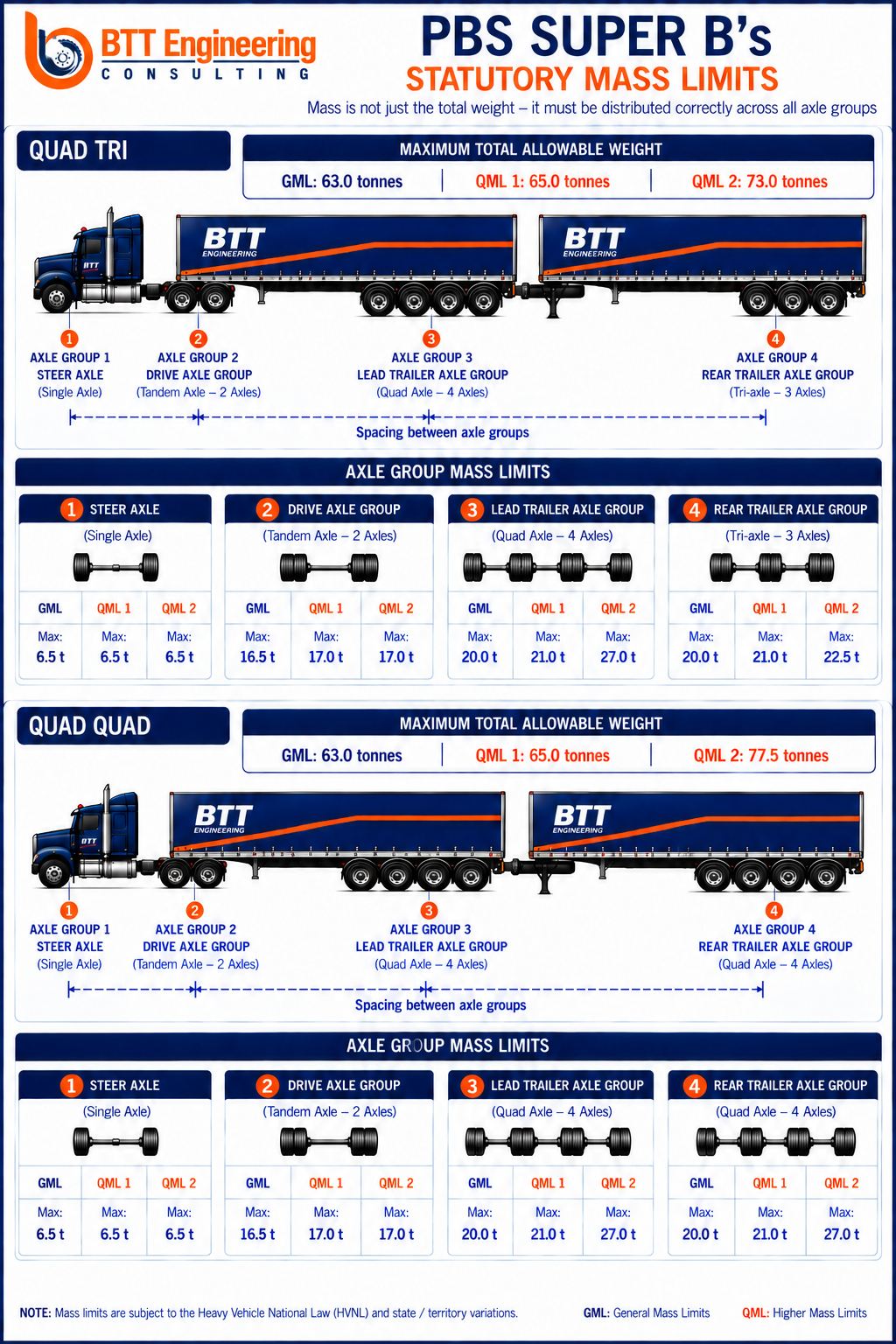
Quad Tri and Quad Quad: what is the difference?
The terms Quad Tri and Quad Quad describe the axle groups fitted to the two trailers within the Super B combination.
Quad Tri Super B
A Quad Tri configuration generally combines one trailer with a quad-axle group and another with a tri-axle group.
This arrangement may suit an operator that wants some of the load-distribution benefits of a quad axle while balancing factors such as tare weight, payload, manoeuvrability and the requirements of the freight task.
Quad Quad Super B
A Quad Quad configuration generally uses a quad-axle group on both trailers.
The additional axle can create opportunities for greater mass and improved load distribution, subject to the approved vehicle design, individual axle-group limits and the capacity of the road network.
The most suitable option will depend on the freight being carried, the vehicle specification, loading requirements and the routes on which the combination needs to operate.
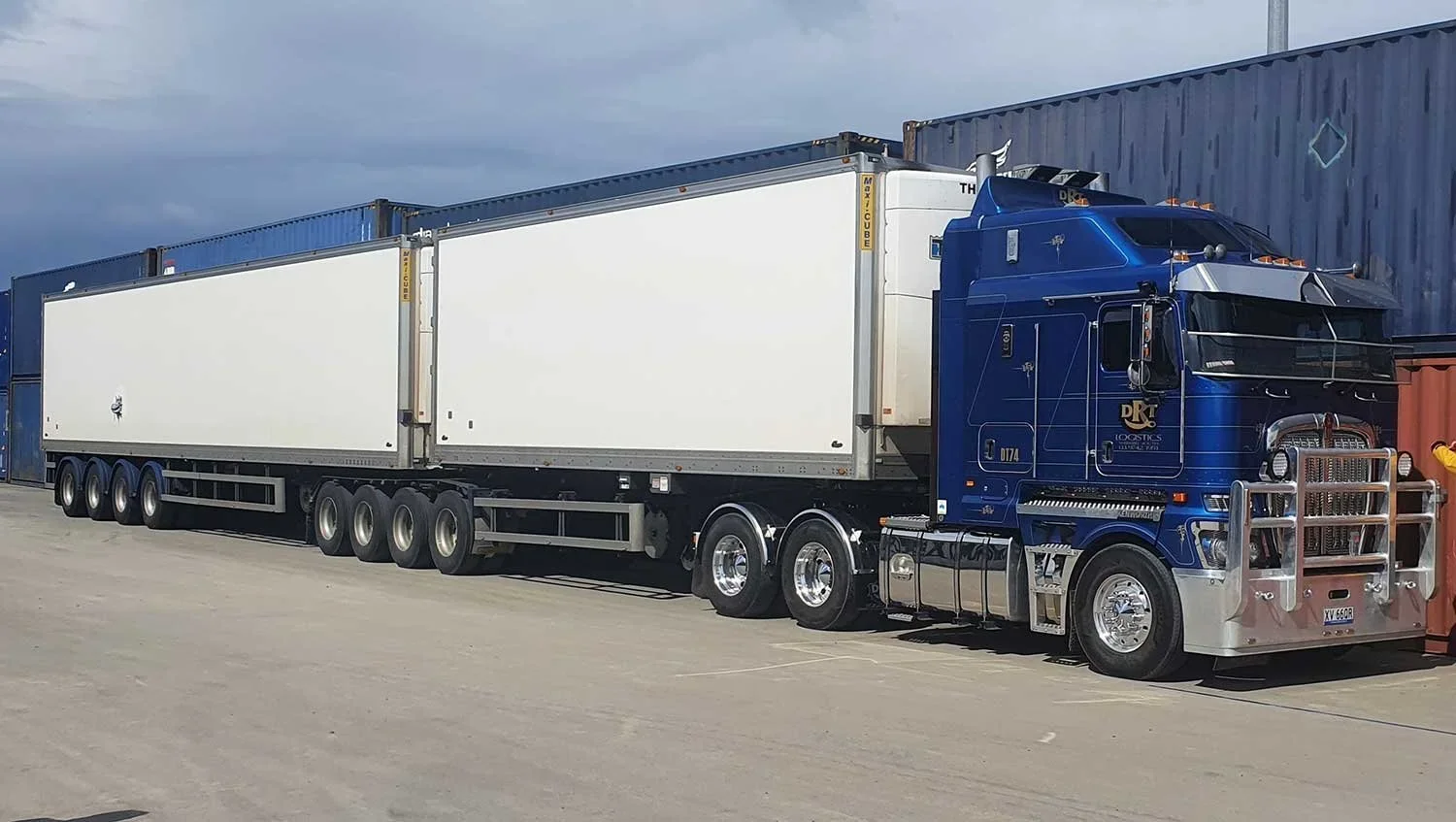
Why are operators considering quad axle combinations?
Greater freight productivity
Where the vehicle and route are approved for the required mass, a quad axle configuration may allow an operator to carry more freight in each movement. This can reduce the number of trips needed to complete a transport task and improve overall fleet productivity.
Better load distribution
Additional axles allow mass to be distributed across more wheels. This can assist operators in managing axle-group limits and balancing the combination correctly.
Improved vehicle stability
When properly designed, loaded and operated, quad axle combinations can provide stable performance for heavy freight tasks. Vehicle stability still depends on the complete design, load placement, suspension, tyres, operating conditions and driver behaviour.
PBS approval and route access are separate requirements
Access may be available through an approved PBS network, a notice or a route-specific permit. If a required road is not already available to the combination at the intended mass, an access application may need to be assessed by the relevant road manager.
This is why route planning should begin early. Confirming likely access before finalising or purchasing a combination can reduce the risk of having a productive vehicle that cannot reach its regular loading or delivery locations.
How BTT Engineering can help
BTT Engineering can support operators throughout the PBS and access process, including:
reviewing proposed vehicle configurations;
assisting with PBS design and approval requirements;
assessing Quad Tri and Quad Quad options;
identifying relevant networks and route constraints;
preparing heavy vehicle access permit applications;
communicating with the NHVR and road managers; and
helping operators understand approval conditions and mass requirements.
The right quad axle combination can create valuable productivity opportunities, but the vehicle design, allowable mass and required routes need to work together.