
Tag Trailer Rules and the 20m Heavy Vehicle Length Limit: What Operators Need to Know
Changes to heavy vehicle mass and dimension rules have introduced greater flexibility for certain truck and trailer combinations.
This includes updates to the tag trailer tow mass ratio and an increase to the prescriptive length limit for eligible combinations. Both changes come with conditions that need to be checked against your specific vehicle pairing.
What has changed for tag trailer combinations?
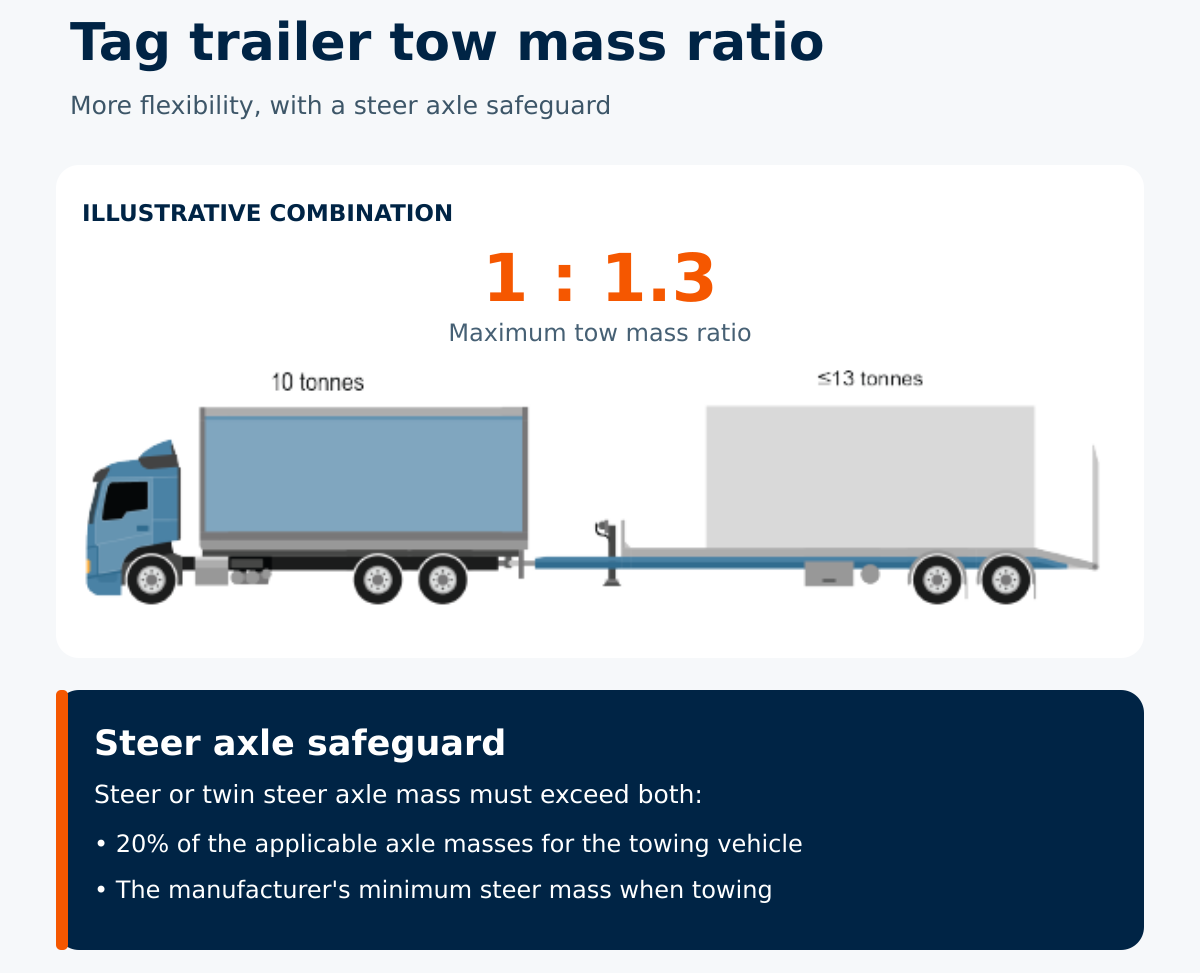
The previous 1:1 tow mass ratio has been replaced by 1:1.3. This allows the mass carried on the tag trailer’s axle or axle group to be up to 30% greater than the combined mass carried on all axles of the towing vehicle.
The increased ratio is paired with a minimum steer axle mass requirement to help maintain safe steering.
Minimum steer axle mass requirements
The towing vehicle’s steer axle or twin steer axle group must carry at least the higher of:
20% of the combined mass limits applying to all axle groups and single axles of the towing vehicle; or
The manufacturer’s minimum steer or twin steer axle mass requirement when towing.
Meeting the tow mass ratio alone does not establish the combination’s towing capacity. Vehicle ratings, axle limits, GVM, GCM and the capacities of the coupling, towbar and drawbar also need to be considered.
Which heavy vehicle combinations can operate at 20m?
The prescriptive length limit has now increased from 19m to 20m for certain combinations, subject to the applicable conditions:
Prime mover and semitrailer.
Rigid truck and pig trailer.
Rigid truck and dog trailer.
Rigid truck and tag trailer.
This change gives eligible operators an additional metre of overall combination length, provided the vehicle pairing meets the relevant dimensional and equipment requirements.
Trailer braking requirements for combinations over 19m
For combinations longer than 19m and up to 20m, each heavy trailer must have a braking system that:
Complies with ADR 38/05 or a later version of ADR 38; and
Is powered by the towing vehicle.
Operators should confirm the trailer’s braking compliance and its connection to the towing vehicle before relying on the increased length limit.
Prime mover and semitrailer dimensional requirements
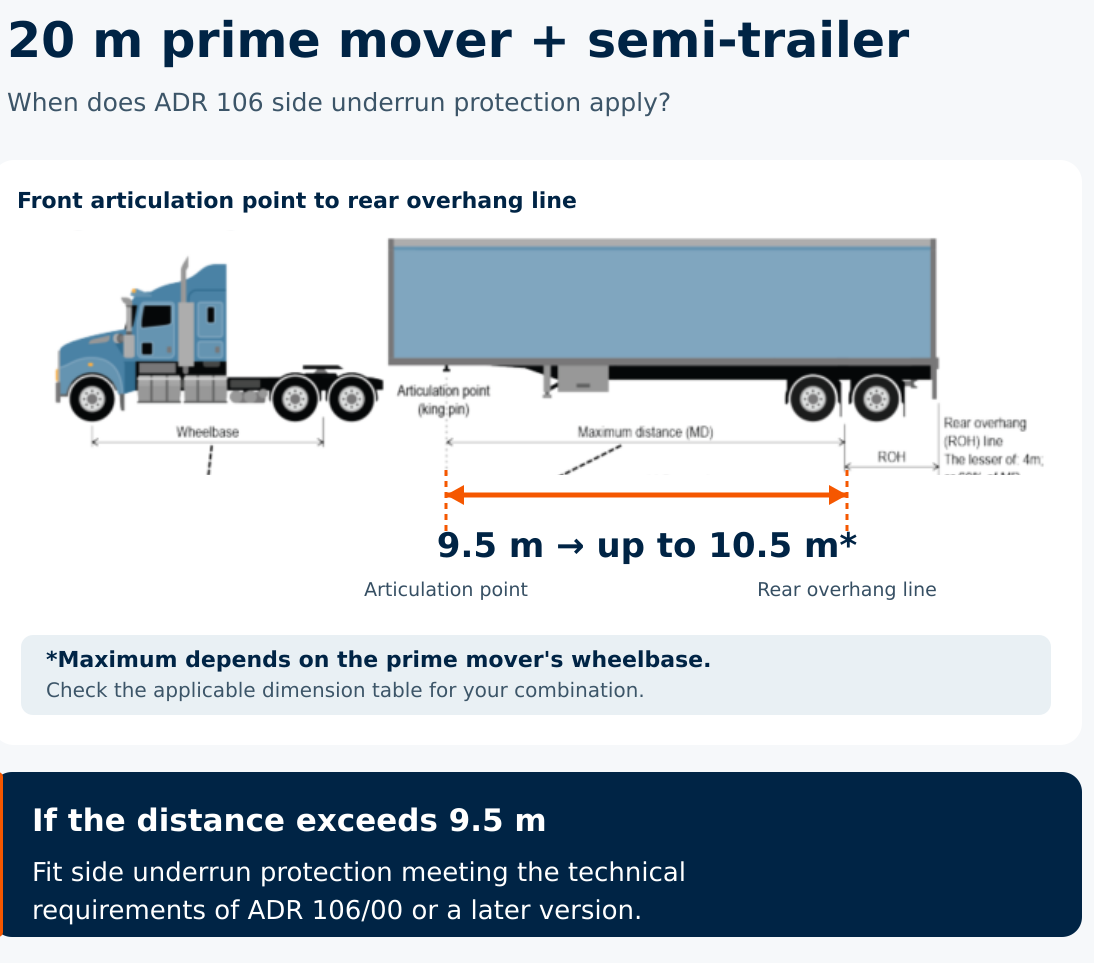
For eligible prime mover and semitrailer combinations, the permitted distance from the trailer’s front articulation point to its rear overhang line can be up to 10.5m, depending on the prime mover’s wheelbase.
The applicable wheelbase table determines the permitted distance, so 10.5m is not available to every pairing.
Where this trailer dimension exceeds 9.5m, the semitrailer must have side underrun protection complying with ADR 106/00 or a later version of ADR 106.
What does the 20m limit mean for rigid truck combinations?
For rigid trucks towing dog, pig or tag trailers, the extra overall length allows flexibility in the truck portion of the combination. It does not provide a general increase to the trailer’s dimensional limits.
Existing trailer dimensions, drawbar requirements and rear overhang limits still need to be checked.
Check your combination before using the updated limits
A 20m overall measurement is only one part of the assessment. A useful review should cover:
Overall combination length and individual vehicle dimensions.
Prime mover wheelbase and semitrailer dimensions, where applicable.
Trailer braking equipment and towing vehicle power supply.
Side underrun protection, where required.
Tag trailer tow mass ratio and minimum steer axle mass.
Vehicle ratings, applicable mass limits and route access requirements.
How BTT Engineering can help
BTT Engineering can help assess your truck and trailer configuration, mass calculations, dimensional compliance and access requirements.
Whether you are reviewing an existing tag trailer combination or considering a vehicle pairing under the new 20m length limit, our team can help you understand the requirements that apply.